Key Summary
Heavy-duty walkers are specially designed for seniors who need enhanced balance, durability, and weight support. They offer broader frames, strong materials, larger wheels, and ergonomic grips, making them perfect for users with limited mobility or higher body weight. In this guide, you’ll find an in-depth analysis of features, benefits, types, comparisons, and expert recommendations on why heavy-duty walkers are often the best option for seniors requiring extra stability.Many seniors struggle with maintaining balance and stability, especially as age-related conditions like arthritis, obesity, or muscle weakness progress. Falls become more frequent, mobility declines, and confidence often takes a hit. Standard walkers may not always provide the robust support required for heavier users or those with more significant mobility limitations.
This lack of support can lead to avoidable injuries, hospitalizations, and a decline in quality of life. Seniors may avoid daily walks, social activities, or even simple chores out of fear of falling or fatigue. Not having the right mobility aid can significantly affect independence and mental well-being.
Heavy-duty walkers are purpose-built to offer maximum stability, safety, and confidence. With their sturdy construction, higher weight capacity, and enhanced features like wider frames and durable wheels, they empower seniors to walk safely and comfortably, indoors and outdoors. In this comprehensive guide, we explore why heavy-duty walkers are a top choice and how to choose the best one for your needs.
Table of Contents
What Are Heavy-Duty Walkers?
Heavy-duty or bariatric walkers are robust mobility aids designed to support seniors who require more weight capacity and stability than standard walkers provide. Most models support 400–500 lbs and are built with high-strength steel or aluminum frames.
They’re equipped with:
- Wide frames for stability
- Padded seats for rest
- Extra-large wheels for outdoor terrain
- Loop-lock brakes and height adjustability
These features are especially beneficial for seniors recovering from surgery or those with arthritis, obesity, or balance issues.
Related: Best Heavy-Duty Walkers for Seniors
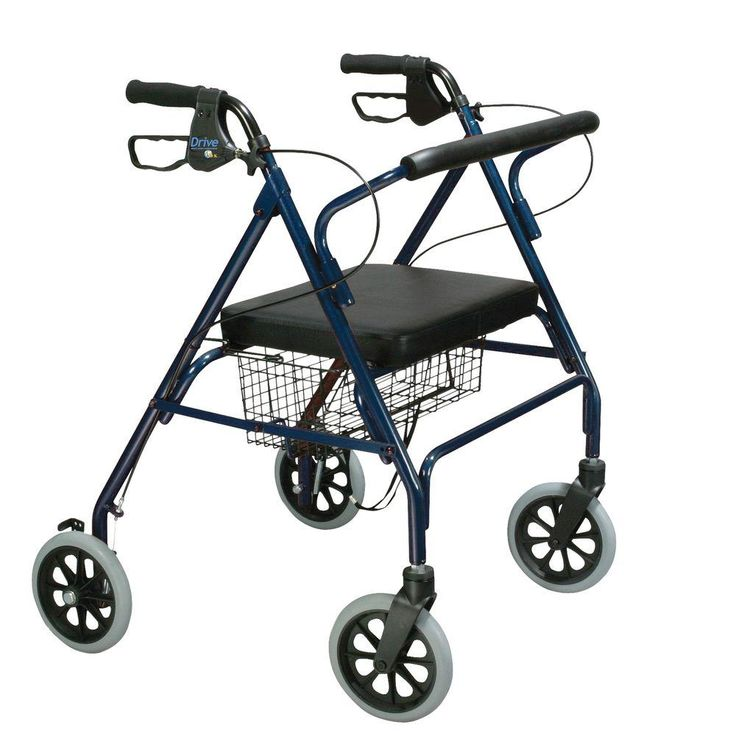
Image Source: Pinterest (https://pin.it/3Lcz275rc,https://pin.it/1pOrgiOZn)
Why Stability Matters for Seniors?
Stability is a key concern for seniors as aging muscles weaken, joints become stiffer, and reflexes slow down.
A heavy-duty walker reduces fall risk by offering:
- A wider base of support
- Non-slip wheels or rubber-tipped legs
- Sturdy handgrips for better control
- Built-in braking systems (in rolling models)
These features enable seniors to move with confidence, even on uneven surfaces or during fatigue. The added stability also supports conditions like Parkinson’s, multiple sclerosis, or post-stroke recovery, where a sudden shift in balance can lead to severe consequences.
Key Features of Heavy-Duty Walkers
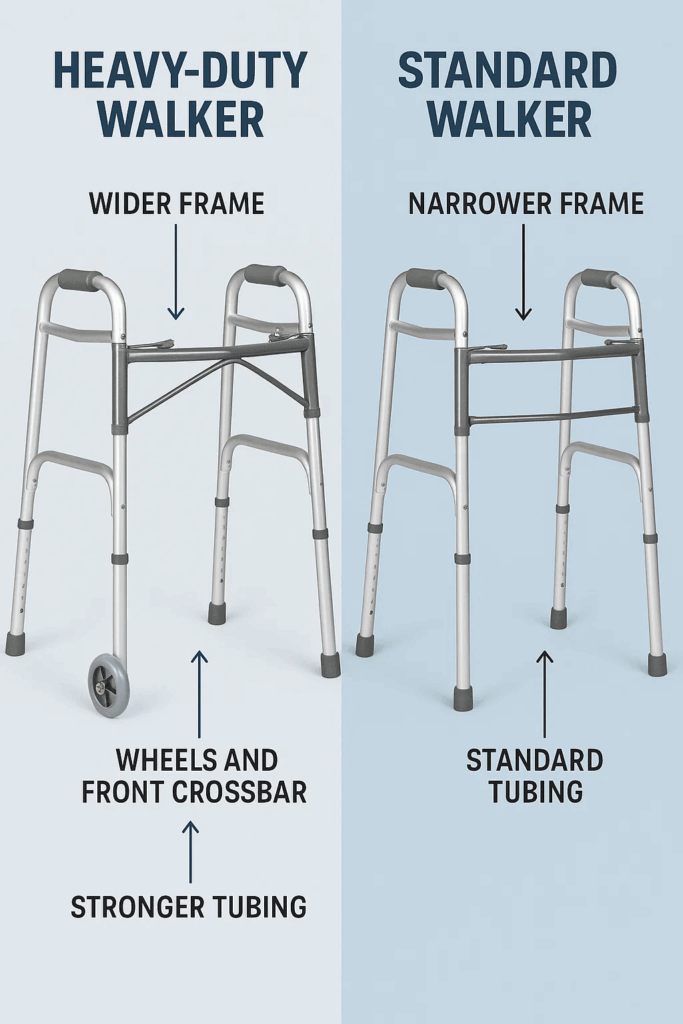
Heavy-duty walkers include several enhanced features that distinguish them from regular walkers. These features make them ideal for seniors needing a dependable, long-term mobility solution:
- High weight capacity: Typically supports 350–500 lbs
- Reinforced frame: Often made from steel or dual-frame aluminum
- Larger wheels: 8–10 inches for smoother rolling on all surfaces
- Seat & backrest: For seated breaks during longer walks
- Dual brakes: Loop-lock or push-down for added safety
- Wide frame: Offers more room and stability for larger users
According to Mobility Deck, these features contribute to reduced strain on joints and lower fall risk, particularly for seniors with compromised lower-body strength.
Types of Heavy-Duty Walkers
There are different styles of heavy-duty walkers, each serving distinct needs:
- Standard Bariatric Walkers:
- No wheels; offer maximum stability.
- Ideal for indoor use or post-surgery recovery.
- No wheels; offer maximum stability.
- 2-Wheel Walkers:
- Two front wheels for easy glide, rubber tips at the back.
- Good for those who need partial weight-bearing support.
- Two front wheels for easy glide, rubber tips at the back.
- 4-Wheel Rollators:
- Full mobility with brakes, large wheels, and a seat.
- Great for active seniors who need frequent breaks.
- Full mobility with brakes, large wheels, and a seat.
- Stand-Up Heavy-Duty Walkers:
- Promote upright posture and reduce hunching.
- Useful for seniors with back or shoulder issues.
- Promote upright posture and reduce hunching.
See more: Best Stand-Up Walkers for Seniors
Who Should Consider Using a Heavy-Duty Walker?
Heavy-duty walkers are recommended for:
- People over 250–300 lbs require walkers that support higher weight limits.
- Individuals recovering from joint replacement surgeries
- Individuals who suffer from chronic conditions such as arthritis, multiple sclerosis, or stroke require specialized mobility support.
- People who need wide walking frames to maintain balance should consider heavy-duty walkers.
- Individuals who experience chronic fatigue or lack strong grip capabilities
Selecting the correct walker requires consideration of body weight, together with mobility capacity and daily lifestyle needs. The Cleveland Clinic reports that selecting or using walkers incorrectly can raise the chance of falls instead of lowering it.
Why Are Heavy-Duty Walkers a Good Option for Seniors?
Heavy-duty walkers provide value through:
- Increased weight support for bariatric users
- Sturdy frames combined with wide bases create safer walker options.
- Outdoor use benefits from improved mobility thanks to the inclusion of larger wheels.
- Postural benefits via upright handle designs
- The product includes built-in padded seats and brakes for added comfort.
- Long-term value through durability and customizability
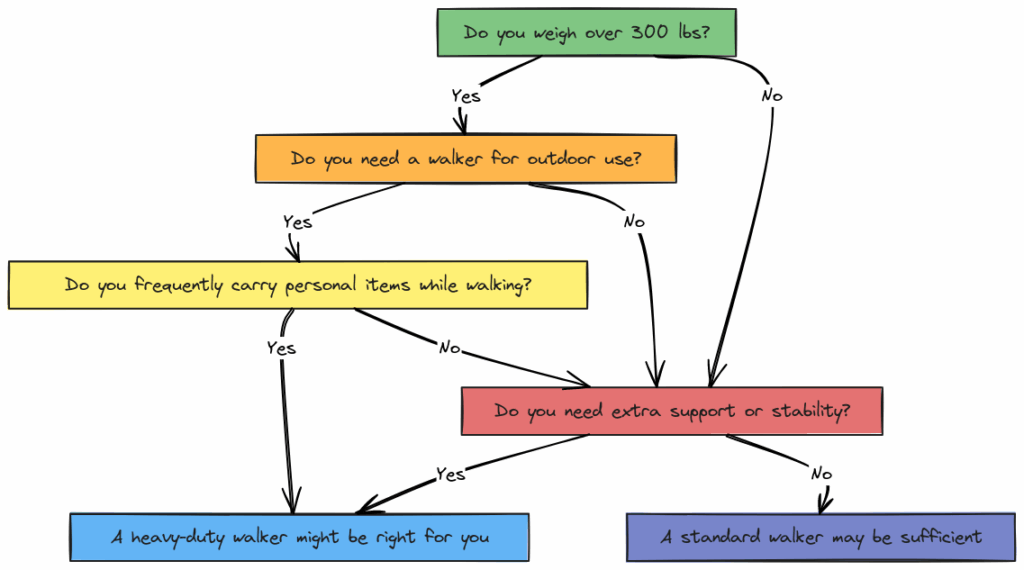
Top Heavy-Duty Walker Options Worth Considering
|
Brand and Model
|
Weight Capacity
|
Key Features
|
Best for
|
|---|---|---|---|
|
NOVA Mighty Mack Heavy-Duty Walker
|
500 lbs
|
Extra-wide frame,8'' Wheels, seat with backrest
|
Heavier seniors, wide walkers
|
|
Drive Medical nitro heavy-duty Rollator
|
400 lbs
|
10'' wheels, foldable frame, under-seat storage
|
Outdoor users, tall individuals
|
|
Medline heavy-duty Rollator
|
500 lbs
|
Steel build, loop-lovk brakes, paddled seat
|
Indoor/outdoor balanced use
|
|
Vive mobility bariartic walker
|
500 lbs
|
Foldable, dual brakes, adjustable frame
|
Seniors with reduced grip strength
|
|
OasisSpace Upright Heavy-duty walker
|
450 lbs
|
Posture design, armrests, 10'' wheels
|
Back issues, posture correction
|
What to Look for in a Heavy-Duty Walker
Factors to Consider:
- Maximum Weight: At least 50 lbs higher than the body weight of the user
- Wheel size: 8” minimum for outdoor use
- Seat height& Width: Adjust the height between the user’s hip and the ground
- Adjustable handles: Aids in posture
- Foldable: Yes, for easy storage and transportation
- Brakes: Loop-lock brakes control the best
Bonus Tip: Test walker height to ensure elbows bend at 15–20 degrees for optimal comfort and safety.
Expert Tips for Safe Use
- Always lock the brakes before sitting
- Avoid using the seat while the walker is moving
- Walk between the handles, not behind them
- Keep pathways at home clear of rugs or cords
- Adjust walker height regularly as needed
- Replace worn-out grips or wheels
Comparison of Key Features
|
Feature
|
Standard Walker
|
Heavy-Duty Walker
|
Stand-Up Walker
|
|---|---|---|---|
|
Weight Capacity
|
250-300 lbs
|
400-500 lbs
|
300-400 lbs
|
|
Wheel Size
|
6-8 iinches
|
8-10 inches
|
10 inches
|
|
Seat Included
|
Sometimes
|
Yes
|
Yes
|
|
Foldability
|
Yes
|
Yes
|
Yes
|
|
Ideal User
|
Average Senior
|
Heavier Senior
|
Posture Focused
|
Frequently Asked Questions
Are heavy-duty walkers harder to maneuver?
No. Many come with large wheels and ergonomic brakes, making them surprisingly easy to steer—indoors or out.
Can I use a heavy-duty walker on uneven terrain?
Yes. Walkers with 8–10” wheels are specifically designed for gravel, grass, and inclines.
Do insurance plans cover heavy-duty walkers?
Most Medicare and private plans do, especially if deemed medically necessary.
Is a stand-up walker also considered a heavy-duty walker?
Some models are. The best stand-up walkers for seniors can provide the dual benefits of posture support and weight capacity.
-
Final Thoughts
Heavy-duty walkers are more than just mobility aids—they’re confidence boosters and safety tools that restore independence for seniors with greater support needs. Whether you’re recovering from surgery or managing a chronic condition, investing in the right walker can significantly improve your quality of life. With features tailored for strength, comfort, and stability, these devices empower seniors to move freely, safely, and with dignity.
-
Reference
Cleveland Clinic. https://my.clevelandclinic.org/
Mobility Deck. https://mobilitydeck.com/
National Institute on Aging. Prevent Falls and Fractures.
https://www.nia.nih.gov/health/prevent-falls-and-fractures